Cleanability: The Overlooked Risk in Mesh Nebulizers for Kids
 Maya ChenContributing Editor
The obsession with portability for kids' nebulizers ignores the single biggest point of failure: a device that's too difficult to properly clean between uses. The conventional wisdom says to prioritize quiet operation and a rechargeable battery. But these features are secondary to the primary risk of a child inhaling bacteria from a poorly cleaned device. Evaluating a nebulizer should start with how quickly it can be disassembled and rinsed—this is more critical to a child's safety than its charging port.
The Anatomy of a Contamination Risk
Here's the part nobody talks about: a complex design with hard-to-reach parts is a liability. It can trap medication residue and moisture, creating a biofilm that fosters bacterial growth. According to the FDA's guidelines on nebulizer care, improper cleaning can lead to lung infections. A nebulizer's effectiveness is nullified if it becomes a vector for illness. The very 'advanced' designs that promise efficiency can become hazardous if every component isn't easily accessible for a thorough rinse and air-drying after each treatment.
Time vs. Sterilization: The Parent Reality

Photo by Max Vakhtbovych on Pexels
Parents managing a sick child do not have the time or energy for a multi-step sterilization process after every 10-minute treatment. A nebulizer that cannot be disassembled and cleaned in under two minutes will, inevitably, be used while dirty. The marketing focus on convenience, such as a USB rechargeable nebulizer machine, misses this crucial point. The real-world bottleneck for a parent isn't finding a power outlet; it's finding 15 minutes to scrub tiny components while a child needs comfort. This is the core of the portability paradox of mesh nebulizers for kids—where features designed for convenience can inadvertently compromise fundamental hygiene.
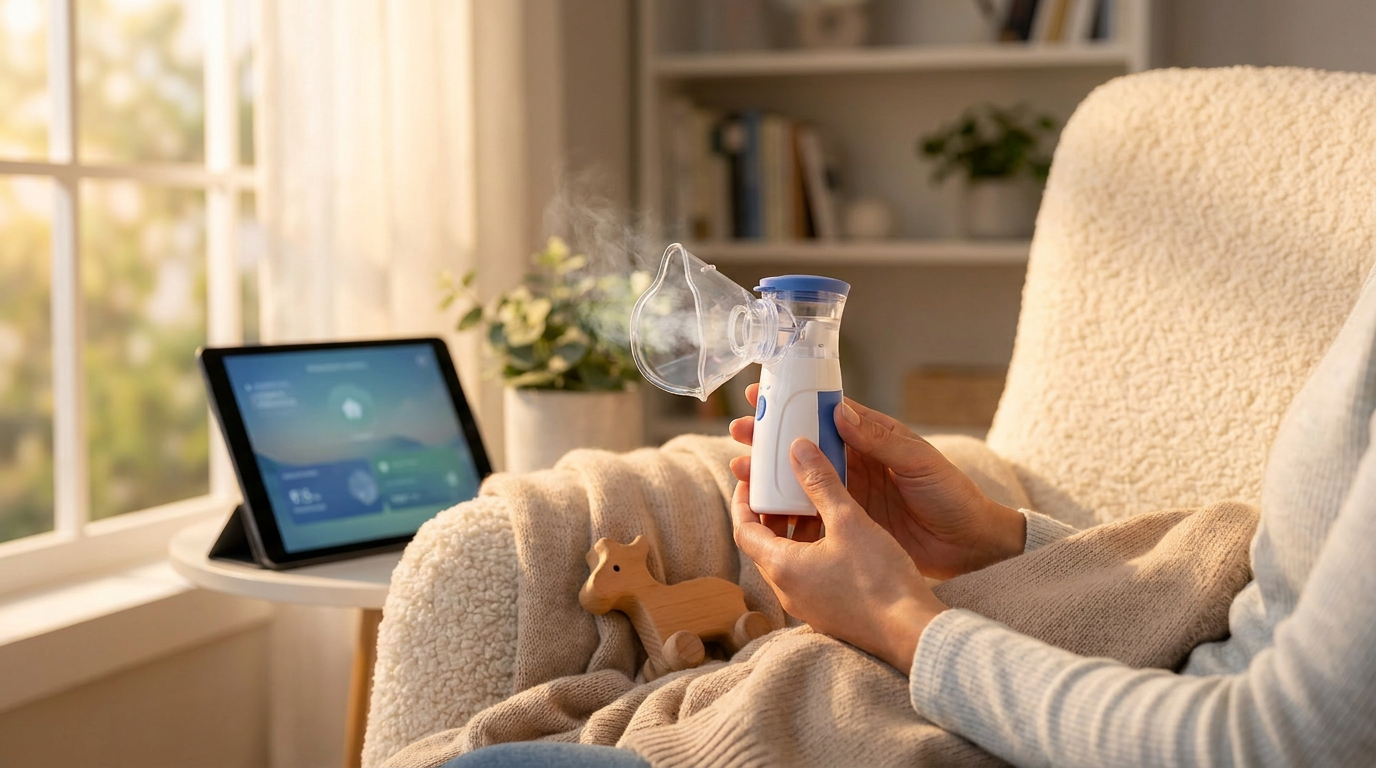
The Portable Smart Nebulizer Humidifier was engineered with a detachable medication cup that separates completely from the mesh element. This allows for a simple rinse-and-dry protocol that takes less than a minute. True pediatric care efficiency is not just about particle size; it is about delivering uncontaminated medication, every single time.
I'll change my mind when manufacturers start advertising their cleaning time in seconds, not their battery life in hours.
What makes a mesh nebulizer difficult to clean?
A device becomes difficult to clean when it has a permanently attached medication cup, narrow channels, or delicate mesh components that cannot be touched or submerged. If a part cannot be fully rinsed from all angles and allowed to air dry completely, it poses a significant risk of trapping moisture and medication residue, which can lead to bacterial colonization.
Is a quiet motor the most important feature for kids?

Photo by Max Vakhtbovych on Pexels
While a quiet motor reduces a child's anxiety during treatment, it does not impact the physical safety of the medication delivered. A silent device that harbors bacteria is more dangerous than a louder, sterile one. The first priority for any medical device used on a child must be hygiene. All other features, including noise level and portability, are secondary to ensuring the device is clean.