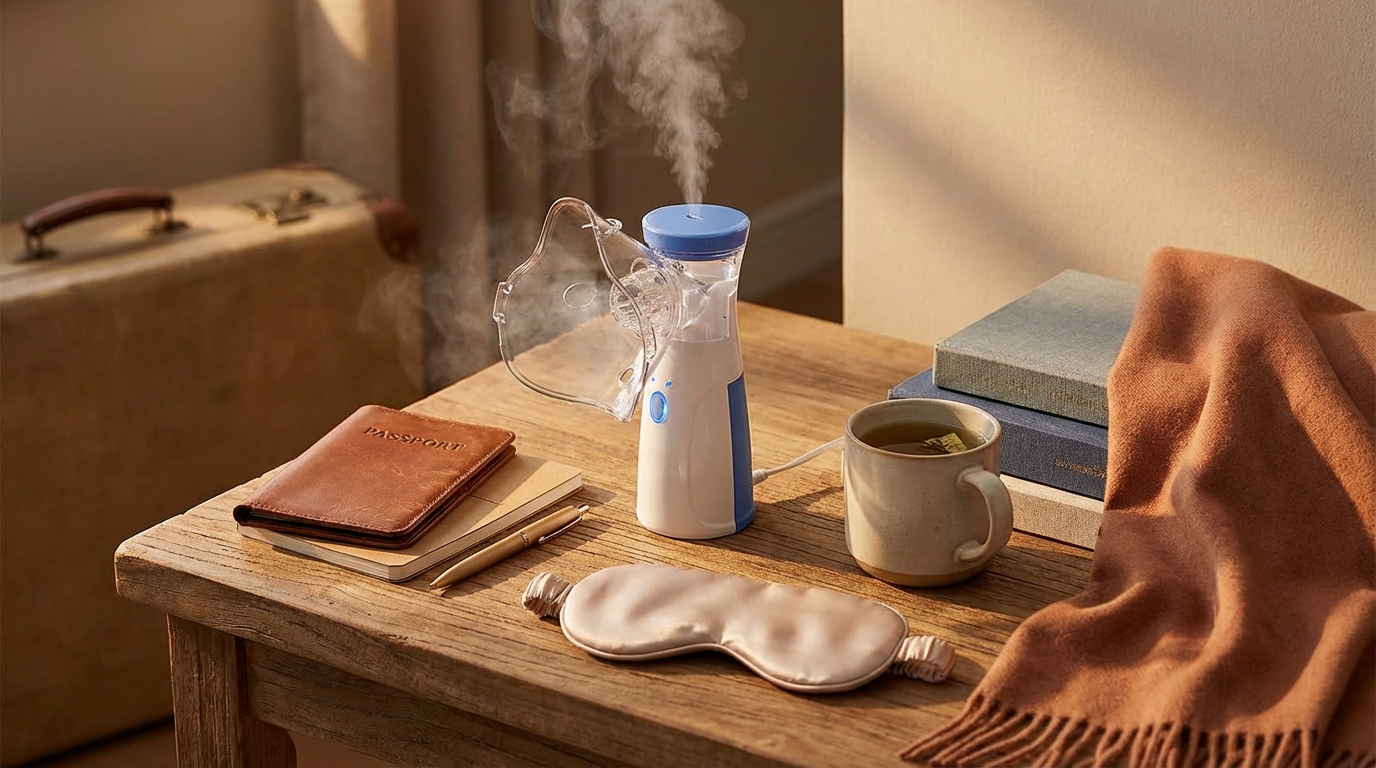
The Flaw in Your Travel Humidifier for Hotel Room Use
 Maya ChenContributing Editor
The travel humidifier industry is obsessed with portability, but the single feature that actually improves your sleep and skin is the one nobody talks about: mist particle size. Waking up to a scratchy throat in a dry hotel room is a common problem, but the accepted solution—a compact, USB-powered device—often fails to address the physics of humidity. The focus on fitting into a carry-on has overshadowed the device's primary function: effectively moisturizing the air you actually breathe.
The Portability Trap and the Damp Nightstand
The conventional wisdom says a travel humidifier for hotel room use must be, above all, small. This has led to a market flooded with cheap ultrasonic devices that create a coarse, heavy mist. These large water droplets are too heavy to remain airborne. They fall within seconds, creating a damp puddle on the nightstand while leaving the air just a few feet away as dry as before. You are not humidifying your personal breathing space; you are just making the furniture wet.
Why Fine Mist Is the Only Metric That Matters
Photo by Max Vakhtbovych on Pexels
Here's the part nobody talks about. Effective humidification depends on aerosol suspension. A nebulizer, by contrast, uses a vibrating mesh to produce an ultra-fine mist. These microscopic particles are light enough to stay suspended in the air for extended periods, creating a personal 'cloud' of humidity that moves with the room's air currents. This is what allows moisture to actually reach and soothe your nasal passages all night. It is the core principle behind effective mesh nebulizer technology, which prioritizes mist quality over simple water output.
The Unseen Consequence: 'White Dust'
Another side effect of using a standard travel humidifier with hotel tap water is the fine white powder left on surfaces. This 'white dust' is the mineral content left behind when large water droplets evaporate. According to the U.S. Environmental Protection Agency, this is a common issue with ultrasonic humidifiers. A nebulizer-based system mitigates this. Because its ultra-fine mist disperses and evaporates in the air rather than on surfaces, mineral deposits have less opportunity to settle on hotel furniture. This is particularly relevant given the variable water quality travelers encounter, a problem that can also affect the longevity of a standard USB rechargeable nebulizer machine.
Is a smaller travel humidifier always better?

Photo by cottonbro studio on Pexels
No. Size is a misleading metric for effectiveness. A tiny device that produces heavy, wet droplets is less effective than one that creates a fine, airborne mist. The goal is to humidify the air you breathe, not the surface of your bedside table. The quality of the mist is a more critical factor for performance, which is why technology like a mesh nebulizer for kids focuses so heavily on particle size.
Why does fine mist matter for sleep quality in a hotel?
During sleep, you are breathing air from your immediate vicinity. A coarse mist from a basic humidifier falls quickly, meaning its benefits are short-lived and localized to a few inches from the device. A fine, nebulized mist remains suspended in the air, creating a consistent, humidified micro-environment around your head. This sustained moisture helps prevent your throat and nasal passages from drying out overnight, leading to less irritation and more restorative sleep.
I'll change my mind when a standard, compact ultrasonic humidifier can produce a mist fine enough to remain airborne for more than a few seconds without leaving a wet residue. Until then, the only metric that counts is particle size.