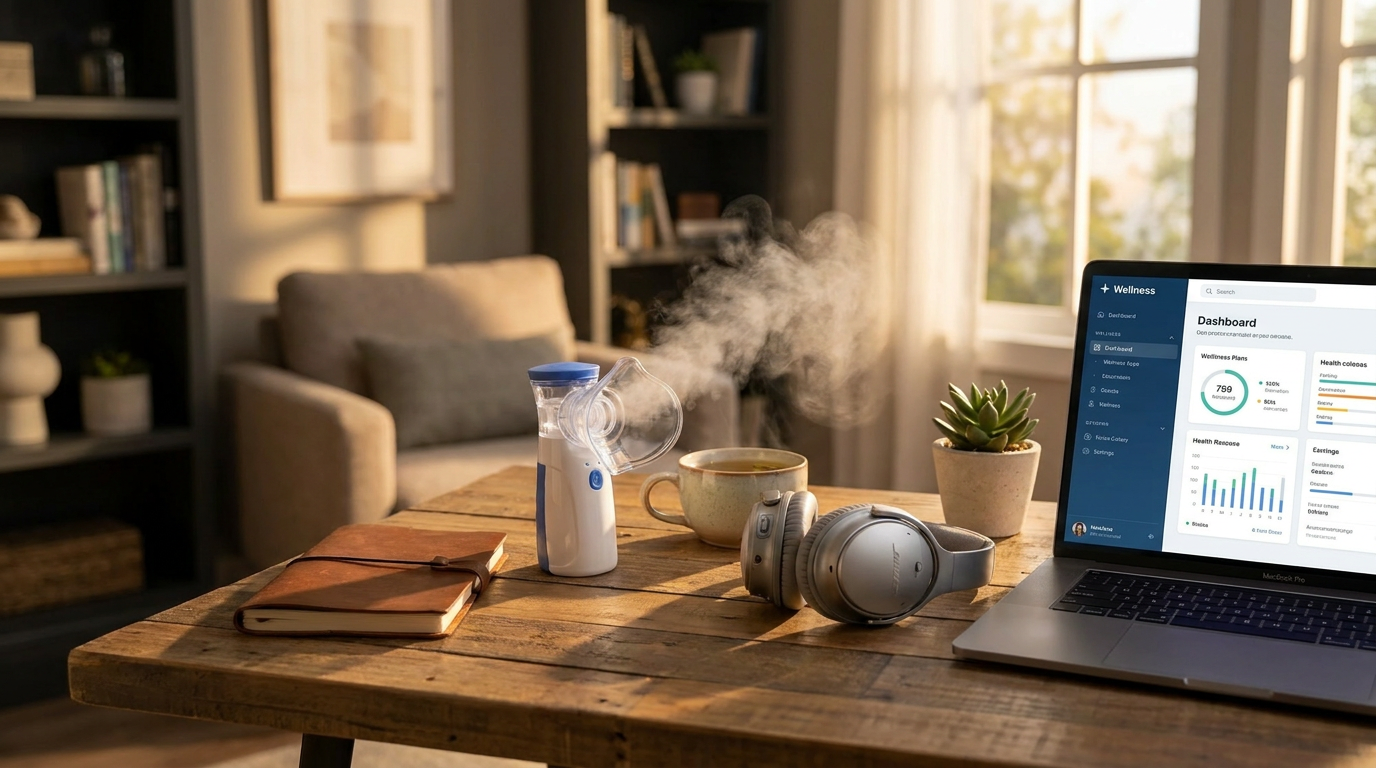
Optimizing the Personal Humidifier for Office Desk Use
 Maya ChenContributing Editor
July 22, 2026. This technical assessment explores the integration of the Portable Smart Nebulizer Humidifier within a professional workspace. It is intended for office workers seeking to mitigate the physiological impacts of climate-controlled environments.
The Inefficiency of Centralized Office HVAC Systems
The conventional wisdom says that modern office HVAC systems are designed for human comfort, yet the data suggests otherwise. Most commercial climate control systems prioritize temperature regulation and energy efficiency over humidity maintenance, often stripping indoor air of moisture until it reaches relative humidity levels below 20%. According to the Occupational Safety and Health Administration (OSHA), while there are no mandatory humidity requirements for office environments, recommended levels for comfort range between 20% and 60%. When levels drop below this threshold, the result is more than just a dry throat; it leads to increased static electricity, ocular discomfort for contact lens wearers, and compromised mucosal barriers. Here's the part nobody talks about: bulky desktop humidifiers often fail in these environments because they lack the precision to deliver moisture directly to the user's breathing zone, instead dissipating into the vast, dry volume of the cubicle farm. This makes the silent portable humidifier for sleep logic—which focuses on localized air quality—highly applicable to the 9-to-5 desk environment. For those managing more complex setups, an app controlled personal humidifier allows for adjustments without interrupting the workflow, providing a layer of automation that centralized systems lack.
Technical Advantages of the Portable Smart Nebulizer Humidifier
Photo by Max Vakhtbovych on Pexels
Transitioning from a passive environment to an active, controlled micro-climate requires hardware that is both discreet and technologically capable. The Portable Smart Nebulizer Humidifier utilizes a mesh nebulizer system, a significant departure from the loud, fan-based evaporative units typically found in retail stores. This mesh technology allows for a consistent, ultra-fine mist that doesn't saturate the desk surface or nearby electronics. Run the math: a standard ultrasonic humidifier may consume 300ml of water per hour, much of which settles as dampness on your keyboard; a precision nebulizer focuses that output, ensuring the user actually breathes the vapor. This is why the device is frequently used as a smart cool mist humidifier app controlled solution for those who need to monitor their air quality in real-time. Because the unit is USB powered and cordless, it bypasses the common office restriction on high-wattage appliances like space heaters or large humidifiers. For parents or caregivers, this same technology functions as a mesh nebulizer for kids or a smart humidifier for baby nursery applications, proving that the hardware is versatile enough for both professional and domestic settings. The silent operation is non-negotiable in an open-office plan where the hum of a traditional motor would be a social liability.
Selecting the Correct Desktop Configuration
Photo by Max Vakhtbovych on Pexels
Choosing a personal humidifier for office desk use requires a different set of criteria than selecting one for a bedroom or a large living area. The focus must be on proximity, noise levels, and maintenance requirements. In an office setting, you are likely dealing with shared air and sensitive electronics, making the delivery method of the moisture critical. I'll change my mind when centralized HVAC systems can provide localized humidity control for individual workstations, but until then, a personal device is the only logical solution. When auditing your workspace for a new device, consider the following technical checklist:
- Power Source: Ensure the device is USB-C compatible or cordless to avoid cluttering limited desk outlets.
- Vapor Delivery: Look for mesh nebulizer technology rather than ultrasonic plates to prevent white dust buildup on monitors.
- Noise Level: The unit must operate under 30 decibels to remain indistinguishable from background office noise.
- Control Interface: Prioritize models that offer app-based control to avoid manual buttons that draw attention to the device.
- Tank Capacity: For a full workday, a capacity of at least 100ml to 200ml is necessary to avoid frequent trips to the office kitchen.
- Footprint: The base should occupy no more than 15 square inches of desk space.